

Stories
Research Update: 22 October 2026
October 22, 2026
 The weekly Research Update contains the latest news, journal articles, and useful links from around the web. Some of this week's topics include:
● MDMA-Assisted Therapy May Decrease PTSD Symptoms, Dissociation, Depression, and Functional Disability: A Systematic Review and Meta-Analysis.
● Predicting US Army Soldier Suicide-Related Behaviors at the Time of Periodic Health Assessments.
● Alcohol Consumption Patterns Before and After Retirement: A Longitudinal Cohort Study Within the Survey of Health, Ageing and Retirement in Europe (SHARE).
● Trends in the Prevalence and Severity of Alcohol and Cannabis Use Disorders Among US Adults.
CLICK HERE TO READ THE 22 OCTOBER 2026 RESEARCH UPDATE
Staff Perspective: 'Tis the Season for Spooky Therapists
October 21, 2026
 The portrayal of therapists in the media has always been fascinating to me. On one hand, I see it as a reflection of how well we, as behavioral health professionals, are (or aren't) marketing ourselves. When therapy is misunderstood or reduced to clichés, it signals that we still have work to do in advocating for our profession and communicating the true depth of what we offer. At the same time, media can be a surprising barometer for how far the field has come. I love when a character casually uses body-positive language, talks about self-compassion, or references exposure therapy—those buzzwords tell me that some writer probably had a good experience in the therapy room. It’s encouraging to see those moments woven into stories.
But then there’s the flip side- the absolute absurdity that Halloween can bring. This is the time of year when therapists in movies or shows become hilariously off-base: spooky, sinister, clueless, or completely terrifying. So in the spirit of spooky season, let's have a laugh, or a shiver, and take a look at four Halloween films and their portrayal of behavioral health providers. (And warning, there are spoilers included below!)
1. Casper (1995): The Ghost Therapist Who Got Too Close
Let’s kick things off with a beloved 90s Halloween classic: Casper. In this film, we meet Kat, a high school student whose mother has recently passed away. Her father, Dr. James Harvey, is a psychiatrist who—grief-stricken after his wife’s death—makes a rather dramatic pivot in his practice: he begins treating ghosts.
Dr. Harvey moves into a haunted mansion with his daughter and his new clients, the mischievous ghost trio: Stinky, Stretch, and Fatso. In the case of Dr. Harvey, there appear to be minimal boundaries. He dines with his ghostly patients. Lives with them, and even goes out drinking with spectors. Unsurprisingly, this all ends poorly; after a night of ghostly revelry, Dr. Harvey drunkenly stumbles into an open sewer hole and dies. Luckily, thanks to a resurrection machine, he’s brought back to life and reunited with Kat.
Whether or not he made therapeutic progress with his ghostly patients remains unclear—but he is rewarded with a fleeting, emotional visit from his deceased wife, who is now an angel.
2. Wednesday (2022): Therapy as Punishment?
Next up is the more recent TV show, Wednesday. After a particularly creative act of revenge involving a school bully and a pool full of piranhas, Wednesday Addams is expelled. The only school willing to accept her does so on one condition: she must attend therapy with Dr. Valerie Kinbott.
From their very first session, Dr. Kinbott and Wednesday are visually and emotionally at odds—Kinbott is dressed in pristine white, while Wednesday is, of course, clad in black. Rather than building rapport, their sessions become a battleground. Wednesday frequently escapes (or attempts to), and their interactions feel more like a power struggle than a therapeutic alliance. One exchange sums up their dynamic perfectly. When Dr. Kinbott encourages her to open up emotionally, Wednesday deadpans: “Emotions are a gateway trait. They lead to feelings, which lead to tears. I don’t do tears.”
Their relationship never evolves beyond this standoff. In a twist of dark irony, Wednesday later accuses Dr. Kinbott of being a werewolf—only for Kinbott to end up the victim of one herself.
3. Get Out (2017): The Therapist IS the Villian
In Get Out, the therapist, or psychiatrist in this case, is Missy Armitage, the mother of the protagonist's girlfriend—and she’s a chilling twist on therapy. Under the guise of offering help, she uses hypnosis not to heal, but to control, trapping her racially motivated victims in the terrifying "Sunken Place." Missy weaponizes therapeutic tools to strip people of their autonomy, turning the trust typically associated with mental health professionals into something sinister.
4. The Sixth Sense (1999): The Therapist Who Didn’t Know He Was Dead
Of course, no list would be complete without the ultimate spooky therapist: Dr. Malcolm Crowe from The Sixth Sense. This child psychologist dedicates himself to helping a troubled young boy, Cole, who claims to see dead people. Throughout the film, we watch Dr. Crowe try to determine whether Cole is experiencing severe mental illness or something more supernatural. In one of the most iconic plot twists in film history, we discover that Dr. Crowe is actually dead—and his patient Cole, has been helping him, Dr. Crowe, come to terms with his own death all along.
The opinions in CDP Staff Perspective blogs are solely those of the author and do not necessarily reflect the opinion of the Uniformed Services University of the Health Science or the Department of War.
Amanda McCabe, Psy.D., is a Military Mental Health Psychologist with the Consortium for Defense Psychology (CDP) at the Uniformed Services University of the Health Sciences in Bethesda, Maryland. In this capacity, she develops and presents trainings on a variety of evidence-based therapies. Prior to the CDP, Dr. McCabe served as a clinical psychologist in the Army from 2013 to 2024.
By the Numbers: 19 October 2026
October 19, 2026
3/4
PTSD is highly comorbid with substance use disorders. Intervening early is critical to preventing the onset or escalation of these conditions.
Staff Perspective: Three Circles Exercise for Addiction Recovery
October 14, 2026
By Stefanie Araya
 As a social worker, I often use the phrase, “If you can name it, you can tame it.” I am a big proponent of clarity and clearly identifying both the behaviors we want to avoid and the behaviors we want to implement to promote wellness, and I have found that the three circles exercise does exactly that.
The three circles exercise was first introduced in Sex Addicts Anonymous (SAA) as a recovery tool to define sobriety, identify boundaries, and promote recovery-oriented behaviors. While this worksheet was initially created for individuals experiencing sexual addiction, I have found in my work as a social worker that its principles translate well across many forms of addiction.
It has proven to be a helpful tool for clients to clarify “bottom line behaviors” and identify ways to live a more meaningful and value-congruent life.
Three Circles Exercise:
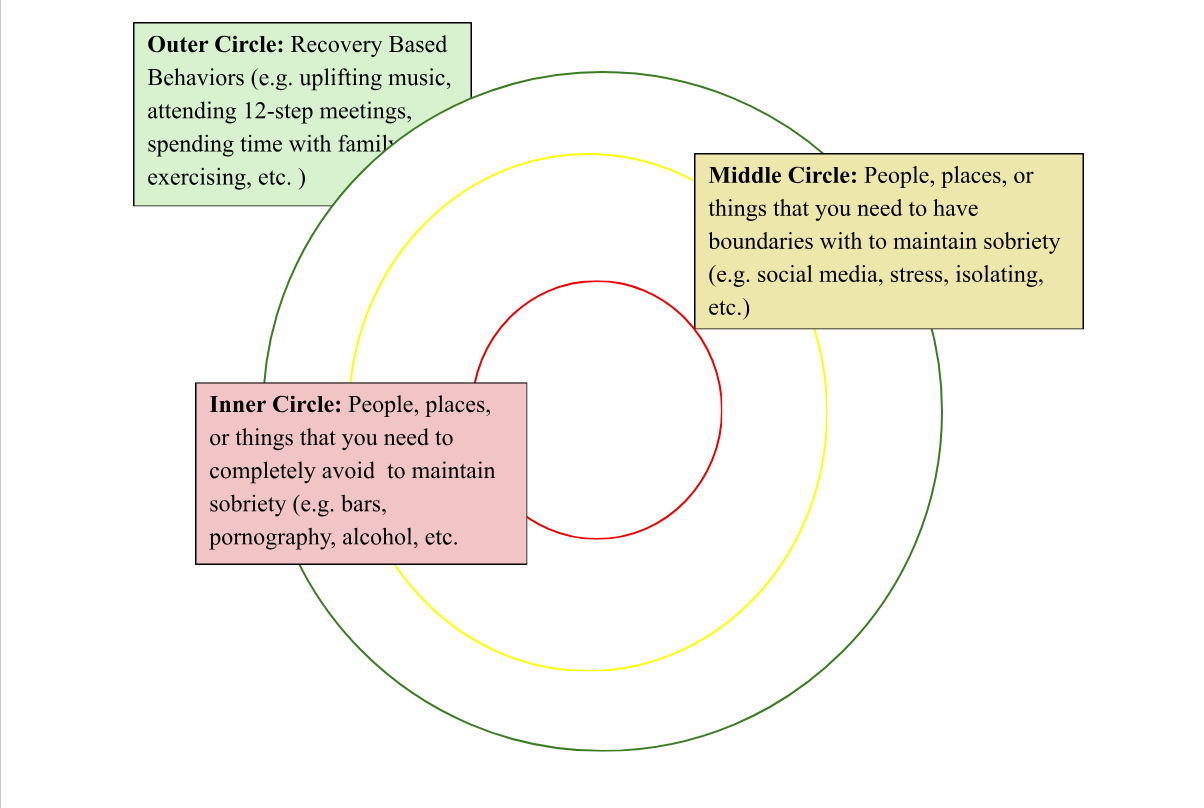
Outer Circle:
In the outer circle, clients identify the things that help them live a life that feels aligned with their values. It is a way for them to clearly outline what a life of recovery looks like for them. It may be spending time with family and friends, attending church, exercising, praying, listening to uplifting music, or meditation. The idea is for clients to list as many people, places, or things that uplift them and help them spark joy in their lives.
Middle Circle:
The middle circle are behaviors that lead to vulnerability. This may be people, places, or things that increase the likelihood of relapse but don’t necessarily cause relapse. This is essentially, a list of things that client’s need to have boundaries with. For some, it may be frequenting a specific restaurant, spending time with a person they use to drink with, social media, secret keeping, or isolating.
Inner Circle:
The inner circle is our abstinence list. This is the things that clients must stay away from to maintain sobriety. For some, this could be alcohol, prescription medications, pornography, bars, clubs, etc.
Putting it in Practice:
The three circles exercise can be a meaningful tool for clinicians to help clients clearly identify their recovery behaviors, boundaries, and what they are truly abstaining from. It allows us to name addiction and recovery with greater clarity, which can make the process of taming it feel more intentional and manageable.
The opinions in CDP Staff Perspective blogs are solely those of the author and do not necessarily reflect the opinion of the Uniformed Services University of the Health Science or the Department of War.
Stefanie Araya is a Licensed Independent Social Worker located in South Carolina and works as a Military Mental Health Social Worker at the Consortium for Defense Psychology (CDP). She is also a Certified Sex Addiction Therapist (CSAT) and a Certified Sex Offender Treatment Professional (CSOTP).
References:
Blevins, T. (2023, January 19). SAA three circles for addiction recovery. Oak Mountain Coaching
Miller, J. (2025). Recovery from sex and love addiction: An exploration of the lived experience of twelve-step affiliation in Sex and Love Addicts Anonymous (Doctoral dissertation, Alliant International University). ProQuest Dissertations & Theses Global. https://www.proquest.com/openview/a4cd4bd0649cb1b34108e220825f59 1a/1
Research Update: 8 October 2026
October 8, 2026
The weekly Research Update contains the latest news, journal articles, and useful links from around the web. Some of this week's topics include:
● A Qualitative Preliminary Study of Ukrainian Healthcare Providers' Perspectives on Service Member's Mental Health Since the Russian Invasion.
● National trends in mental health outcomes among U.S. combat veterans by war era.
● Post-traumatic stress disorder (PTSD) in war: a comprehensive review of subtypes, risk and protective factors, and therapeutic approaches.
● Telehealth and Hybrid Service Use for Major Depression and Substance Use Disorders Among U.S. Adults, 2022–2023.
CLICK HERE TO READ THE 8 OCTOBER 2026 RESEARCH UPDATE
Staff Perspective: Escaping the Thinking Traps that Drive Daily Stress
October 7, 2026
 By Aditi Venkatesh, M.S.
Most of us have negative, irrational thoughts from time to time. If we assume that these thoughts are logical or true, they can shape how we see the world, how we feel, and even how we behave. In my own clinical work, I see how easy it is for patients I work with to fall into these mental loops without even realizing it. Such thoughts are normal occasionally; however, they can become harmful when they are more frequent or are higher in intensity. Clinically, we call these thoughts cognitive distortions, but I prefer to think of them simply as “thinking traps.”
From an evolutionary perspective, these thinking traps are not personal flaws but adaptive survival mechanisms that have gone into overdrive. In high-stakes environments, being hypervigilant and preparing for worst-case scenarios can be helpful in surviving. However, when these survival-based thinking traps are present in daily life, they can become rigid patterns, potentially misinterpreting low-stress situations as high-stress or threatening situations.
For active-duty service members and veterans, navigating unique occupational stressors, unpredictable schedules, and transitions can increase levels of stress. Studies consistently show that elevated stress and anxiety go hand-in-hand with an increase in thinking traps, and it works both ways. This is critical to keep in mind, especially given that over 10% of active-duty service members and 20% of veterans navigate mental health challenges.
Therefore, identifying these thinking traps and learning how to manage them are some of the most important tools we have for protecting our patient’s and our own overall mental well-being.
Spotting Common Thinking Traps in Everyday Life: The Beck Institute identifies several thinking traps that tend to surface when running on low battery or high stress. Here are few of the thinking traps I see most often:
- All-or-nothing thinking: Viewing situations in black-and-white terms without any gray. (Example: “If I don’t execute this task perfectly, all of it is a complete failure.”)
- Catastrophizing: Predicting the worst possible outcome without considering realistic probabilities. (Example: “If I make a mistake during my presentation, my leaders and peers will lose all respect for me.”)
- Disqualifying or discounting the positive: Rejecting positive experiences or successes. (Example: “I excelled on my evaluation, but it was just luck.”)
- Mind reading: Believing you know what others are thinking without any evidence. (Example: “My commander didn’t say hello to me as we passed by each other, so he’s certainly angry with me.”)
- ‘Should’ and ‘must’ statements: Operating with rigid rules for how you, others, or the world must be. (Example: “I should be able to handle all this stress without feeling exhausted.”)
When these thinking traps go unchecked, we can easily get stuck in negative feedback loops that drive up anxiety, stress, burnout, and depression.
Using CBT Techniques to Take Back Control: In cognitive-behavioral therapy (CBT), a modality of therapy developed by Dr. Aaron Beck and expanded by Dr. Judith Beck, our goal isn’t forced optimism or toxic positivity. Instead, we focus on training your brain to test automatic thoughts against reality. CBT is a structured, evidence-based framework that focuses not only on positive thinking, but three core steps: identifying, challenging, and restructuring cognitive distortions.
What this Looks Like when Working with Military Patients: Working with active-duty service members and veterans requires adapting standard CBT techniques to respect and incorporate military culture. Rather than framing a patient’s thoughts as simply “irrational,” I find it far more effective to start by validating that tools, such as catastrophizing, served a vital tactical purpose in operational environments. Following this validation with socratic questioning allows us to collaboratively evaluate whether those same thoughts are still serving them well in daily life as a military service member, veteran, or civilian. By challenging the thought and testing the evidence for their thinking traps, we can frame cognitive restructuring as a practical skill to improve their mental and physical well-being. I’ve seen this to be a way to help military patients manage their unhelpful thinking patterns without undermining their military experiences.
Ultimately, learning to identify and restructure thinking traps is about restoring control and overall mental well-being. For military service members, veterans, and those of us who support them, mastering these cognitive techniques can provide a sustainable and effective way to manage the irrational, automatic thoughts experienced.
Which of these thinking traps do you see yourself, or the military patients you work with, making the most?
The opinions in CDP Staff Perspective blogs are solely those of the author and do not necessarily reflect the opinion of the Uniformed Services University of the Health Science or the Department of War.
Aditi Venkatesh, M.S., is a fourth-year doctoral candidate in the Medical and Clinical Psychology Ph.D. program and a graduate research assistant with the Consortium for Defense Psychology (CDP) at the Uniformed Services University of the Health Sciences in Bethesda, Maryland. Currently, her research focuses on eating- and weight-related concerns in United States military veterans, with a long-term focus on combined research and clinical work in military and veteran behavioral health.
References
Beck, J. S. (2020). Cognitive behavior therapy: Basics and beyond. Guilford Publications.
Division, A. F. H. S. (2026). Diagnoses of mental health disorders among US active component service members, 2020-2024. MSMR, 32(12), 25-35.
Kline, A. C., Panza, K. E., Nichter, B., Tsai, J., Harpaz-Rotem, I., Norman, S. B., & Pietrzak, R. H. (2022). Mental health care use among US military veterans: Results from the 2019–2020 National Health and Resilience in Veterans Study. Psychiatric services, 73(6), 628-635.
Mercan, N., Bulut, M., & Yüksel, Ç. (2023). Investigation of the relatedness of cognitive distortions with emotional expression, anxiety, and depression. Current Psychology, 42(3), 2176-2185.
Shi, Y., Zhang, Y., & Lei, L. (2026). Unmasking mental distress: exploring the spectrum of cognitive distortions associated with symptoms of anxiety, depression, and suicidal ideation. Cognitive processing, 27(1), 227-238.
Shickel, B., Siegel, S., Heesacker, M., Benton, S., & Rashidi, P. (2020, October). Automatic detection and classification of cognitive distortions in mental health text. In 2020 IEEE 20th International Conference on Bioinformatics and Bioengineering (BIBE) (pp. 275-280). IEEE.
By the Numbers: 5 October 2026
October 5, 2026
19.7%
The percentage of "143,747 suicide decedents in National Violent Death Reporting System" from 2020-2023 who "were reported to have physical health problems as a precipitating circumstance for suicide," according to an article in the American Journal of Preventive Medicine -- Physical Health Conditions Among Suicide Decedents: National Violent Death Reporting System, U.S., 2020–2023.
Nearly one quarter of suicide decedents with physical health problems experienced chronic pain, and almost half had at least 1 chronic condition. Decedents with physical health problems were significantly older (x̄=63.3 vs x̄=42.9 years), more likely to have ever served in the military (26.1% vs 12.3%), less likely to have a mental health diagnosis (43.8% vs 50.5%), and more likely to have disclosed current suicidal thoughts or intent (22.6% vs 20.9%; p<0.001) than those without physical health problems.
Research Update: 1 October 2026
October 1, 2026
The weekly Research Update contains the latest news, journal articles, and useful links from around the web. Some of this week's topics include:
● The Military Child & Family Collaboratory: A Content Analysis of Collective Impact Actions for Youth Mental Health, Emotional, Development, and Behavioral Needs.
● U.S. Army Reserve and National Guard Soldiers’ Motivations for Joining the Military and Their Effects on Post-Deployment Mental Health.
● Suicide Prevention in the US Military: Assessing the Impact of the Brandon Act.
● U.S. Combat Medicine and Military Morale.
CLICK HERE TO READ THE 1 OCTOBER 2026 RESEARCH UPDATE
Staff Perspective - Safeguard Project Update: Bringing the Right Suicide Prevention and PTSD Support to Veterans
September 30, 2026
 By Jessica Soule, LCSW
Funded by the VA Office of Suicide Prevention, Safeguard Veterans is a one-year pilot research program designed to unite community partners—including 13 key collaborators operating across six target cities—to strengthen the existing web of care surrounding our veterans. The Consortium for Defense Psychology (CDP) plays a vital role in this effort by equipping community providers with evidence-based suicide prevention and trauma-focused training and creating a tailored referral tool that aims to ensure veterans receive top-tier care, no matter where they seek PTSD treatment.
A core pillar of CDP’s work focuses on direct clinical education. To date, Safeguard has reached over 400 attendees through free, virtual workshops centered on Cognitive Behavioral Therapy for Suicide Prevention (CBT-SP), Problem Solving Therapy for Suicide Prevention (PST-SP), and Safety Planning.
CDP’s PTSD training curriculum features an innovative twist: equipping clinicians to deliver Prolonged Exposure Therapy (PE) and Cognitive Processing Therapy (CPT) in both traditional outpatient therapy formats and massed (condensed) schedules. While PE and CPT are highly effective treatments, traditional weekly therapy sometimes poses significant hurdles—ranging from practical scheduling conflicts to the anticipatory anxiety of repeatedly confronting trauma over several months. The best treatments only work if clients can stick with them; by offering condensed delivery options, clinicians can dismantle these barriers and make life-changing trauma care far more accessible and manageable.
To complement virtual training offerings, CDP is delivering immersive in-person trainings across select pilot locations. Following a successful two-day CBT-SP workshop in Fayetteville, NC, and a three-day Prolonged Exposure (PE) workshop in San Antonio, TX, there is still time to sign up for two final in-person trainings:
- Problem Solving Therapy for Suicide Prevention: Las Vegas, NV, 20-21 October 2026
- Cognitive Processing Therapy (CPT): Hampton, VA, 27-29 October 2026
Beyond provider education, CDP is finalizing an online referral tool designed for veterans, their families and caregivers, and community clinicians. Grounded in VA standards of care and refined through target user focus groups, the tool helps users navigate PTSD treatment programs outside the VA system. This ensures veterans who seek care in their local communities receive high-quality, culturally responsive treatment. As Safeguard’s training calendar culminates at the end of October, visit safeguardveterans.net to learn more or register for remaining trainings.
The opinions in CDP Staff Perspective blogs are solely those of the author and do not necessarily reflect the opinion of the Uniformed Services University of the Health Science or the Department of War.
By the Numbers: 28 September 2026
September 28, 2026
$119 billion
The "(t)otal annual cost of morbidity-related productivity losses attributable to" major depressive disorder among U.S. adults, according to an article in the American Journal of Preventive Medicine -- Morbidity-related productivity losses from major depressive disorder among U.S. adults. This equates to $5,824 "per affected adult in 2024."
Inability to work costs accounted for 44% of total productivity losses, followed by presenteeism (33%), absenteeism (18%), and household productivity loss (5%). Total productivity loss costs and per-person loss costs differed by sex.