
By Stefanie Araya
 As a social worker, I often use the phrase, “If you can name it, you can tame it.” I am a big proponent of clarity and clearly identifying both the behaviors we want to avoid and the behaviors we want to implement to promote wellness, and I have found that the three circles exercise does exactly that.
The three circles exercise was first introduced in Sex Addicts Anonymous (SAA) as a recovery tool to define sobriety, identify boundaries, and promote recovery-oriented behaviors. While this worksheet was initially created for individuals experiencing sexual addiction, I have found in my work as a social worker that its principles translate well across many forms of addiction.
It has proven to be a helpful tool for clients to clarify “bottom line behaviors” and identify ways to live a more meaningful and value-congruent life.
Three Circles Exercise:
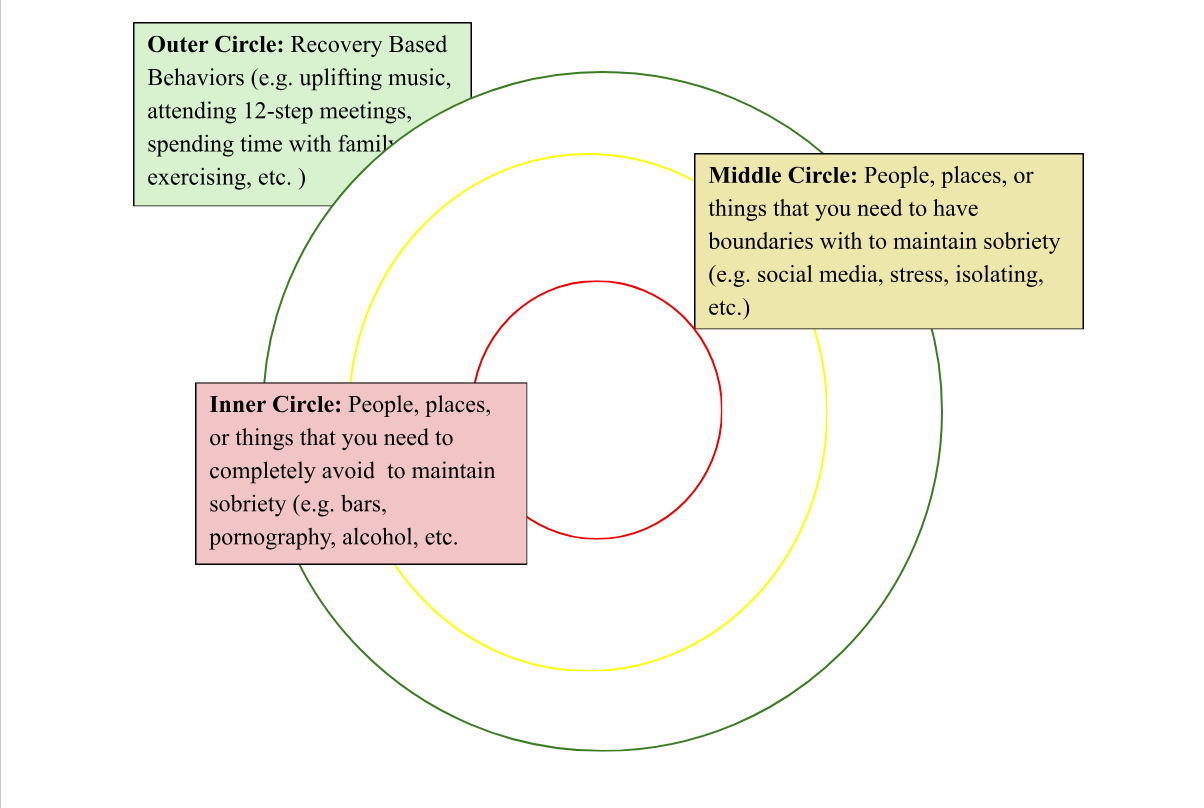
Outer Circle:
In the outer circle, clients identify the things that help them live a life that feels aligned with their values. It is a way for them to clearly outline what a life of recovery looks like for them. It may be spending time with family and friends, attending church, exercising, praying, listening to uplifting music, or meditation. The idea is for clients to list as many people, places, or things that uplift them and help them spark joy in their lives.
Middle Circle:
The middle circle are behaviors that lead to vulnerability. This may be people, places, or things that increase the likelihood of relapse but don’t necessarily cause relapse. This is essentially, a list of things that client’s need to have boundaries with. For some, it may be frequenting a specific restaurant, spending time with a person they use to drink with, social media, secret keeping, or isolating.
Inner Circle:
The inner circle is our abstinence list. This is the things that clients must stay away from to maintain sobriety. For some, this could be alcohol, prescription medications, pornography, bars, clubs, etc.
Putting it in Practice:
The three circles exercise can be a meaningful tool for clinicians to help clients clearly identify their recovery behaviors, boundaries, and what they are truly abstaining from. It allows us to name addiction and recovery with greater clarity, which can make the process of taming it feel more intentional and manageable.
The opinions in CDP Staff Perspective blogs are solely those of the author and do not necessarily reflect the opinion of the Uniformed Services University of the Health Science or the Department of War.
Stefanie Araya is a Licensed Independent Social Worker located in South Carolina and works as a Military Mental Health Social Worker at the Consortium for Defense Psychology (CDP). She is also a Certified Sex Addiction Therapist (CSAT) and a Certified Sex Offender Treatment Professional (CSOTP).
References:
Blevins, T. (2023, January 19). SAA three circles for addiction recovery. Oak Mountain Coaching
Miller, J. (2025). Recovery from sex and love addiction: An exploration of the lived experience of twelve-step affiliation in Sex and Love Addicts Anonymous (Doctoral dissertation, Alliant International University). ProQuest Dissertations & Theses Global. https://www.proquest.com/openview/a4cd4bd0649cb1b34108e220825f59 1a/1