

Stories
Staff Perspective: Beyond the Smoke Pit — The Changing Face of Nicotine Use in the Military
November 4, 2026
 By Kathryn E Monsey, LCSW, LCDC
If you have served in the military—or spent any real time on a military installation—you know the smoke pit. Usually tucked just far enough away from the building to satisfy policy, it has long doubled as an unofficial gathering place. Smoke a cigarette, catch up with someone, get five minutes away from work. For generations of service members, nicotine has been woven into military culture in ways that extend well beyond the cigarette itself.
But nicotine use in the military is starting to look different.
A recent Military Health System analysis of more than 921,000 active-component service members found that 22% reported using a nicotine or tobacco product within the previous 30 days. What caught my attention wasn't just the prevalence, it’s was what they were using. E- cigarettes were reported more than twice as often as cigarettes or chewing tobacco (Rossi et al., 2026).
Then there are nicotine pouches. A study of nearly 2,000 soldiers at Fort Liberty found that almost 24% reported using nicotine pouches within the previous 30 days. Among soldiers ages 17–24, that climbed to nearly 27% (Little et al., 2024).
Those numbers got me thinking less about nicotine itself and more about how the experience of using nicotine has changed.
Cigarettes come with friction. You need to step away. You need somewhere you're allowed to smoke. There's smoke, smell, and a pretty obvious signal to everyone around you about what you've been doing. And as cigarette smoking has become less socially accepted in the broader population, those inconveniences have become increasingly difficult to ignore.
Military culture has always been a little different. Smoking and dipping have maintained a visible presence in military life, and the smoke pit itself became something of a social institution. Nicotine had a place to go—and usually some company waiting there.
Vapes and nicotine pouches change that equation. They're portable, easier to use, produce little or no lingering odor, and are considerably less conspicuous than lighting a cigarette. Nicotine use doesn't necessarily require the same interruption or announce itself in quite the same way.
That raises an interesting question: When nicotine becomes easier to use and less conspicuous, do some of the natural barriers to using it disappear too?
We can't say that the discretion of newer products is driving increased use among service members. But it is worth considering as we try to understand why these products have gained traction, particularly among younger personnel.
There may also be something uniquely military about how this transition plays out. Nicotine has long traveled alongside stress, boredom, long shifts, deployments, downtime, and alcohol. New products don't necessarily change those functions. They may simply make nicotine easier to fit into everyday life.
For clinicians, this raises a more interesting question than simply whether a service member uses nicotine: What happens to a pattern of use when there are fewer reasons to stop? A cigarette comes with built-in boundaries—you have to step away, find a place to smoke, finish the cigarette, and return. Newer products can remove some of those natural stopping points. Nicotine can become easier to pair with drinking, driving, gaming, decompressing after work, or simply filling downtime. Over time, use that began in one specific context can quietly spread into many.
That makes it worth looking not only at frequency, but at how much space nicotine has started to occupy in someone's day. Is it still something they consciously decide to use, or has reaching for it become almost automatic? Are there still parts of the day when they naturally go without it? And when they do, what happens? As nicotine becomes easier to access and less conspicuous, dependence may not always announce itself through dramatic consequences. Sometimes the more telling shift is simply that there are fewer and fewer moments when nicotine isn't there.
The smoke pit isn't going anywhere tomorrow. Cigarettes and dip haven't disappeared either. But they no longer tell the whole story of nicotine use in the military.
As the products change, it's worth paying attention not only to what service members are using, but to how those products may be changing the way nicotine fits into military life.
The opinions in CDP Staff Perspective blogs are solely those of the author and do not necessarily reflect the opinion of the Uniformed Services University of the Health Science or the Department of War.
References
Little, M. A., Polaskey, K. M., Pilehvari, A., Krukowski, R. A., Ribisl, K. M., & Pearce, T. D. (2024).
Nicotine pouch use among US military personnel. JAMA Network Open, 7(12), e2451517.
https://doi.org/10.1001/jamanetworkopen.2024.51517
Rossi, K. R., Russell, S. J., & Mabila, S. L. (2026). Distribution of tobacco and nicotine use
indicators from the Periodic Health Assessment and medical diagnostic codes among U.S. active
component service members, 2023. Medical Surveillance Monthly Report, 33(4).
By the Numbers: 2 November 2026
November 2, 2026
15.3 & 5.6%
"The weighted prevalence of binge and heavy drinking," respectively, among 388,327 adults aged ≥18 years in 2024, according to a study published in the Journal of Preventive Medicine -- Sociodemographic Disparities in Binge and Heavy Drinking Among U.S. Adults, 2024.
Binge drinking was most common among younger adults, males, non-Hispanic Whites, and unmarried adults. Heavy drinking peaked among adults aged 35–44 years and those with some college education. The adjusted odds of binge drinking were lower for adults aged ≥65 years (AOR=0.24, 95% CI=0.22, 0.27) and non-Hispanic Asians (AOR=0.43, 95% CI=0.37, 0.50) and higher for never-married adults (AOR=1.13, 95% CI=1.07, 1.19). For heavy drinking, higher odds were observed for never-married adults (AOR=1.12, 95% CI=1.03, 1.22), those aged 35–44 years (AOR=1.24, 95% CI=1.08, 1.43), and individuals with some college education (AOR=1.24, 95% CI=1.08, 1.43) or a high-school diploma (AOR=1.10, 95% CI=1.02, 1.19).
Research Update: 29 October 2026
October 29, 2026
 The weekly Research Update contains the latest news, journal articles, and useful links from around the web. Some of this week's topics include:
● Diagnoses of Mental Health Disorders Among U.S. Active Component Service
Members, 2021–2025.
● Clinical Evidence on Psilocybin and Its Representation in Media Reporting: A
Systematic Review.
● Concentrated Exposure Therapy vs Internet-Based Cognitive Behavioral Therapy
for Obsessive-Compulsive Disorder: A Randomized Clinical Trial.
● Mortality Among People With Attention-Deficit/Hyperactivity Disorder: A
Systematic Review and Meta-Analysis.
CLICK HERE TO READ THE 29 OCTOBER 2026 RESEARCH UPDATE
Staff Perspective: Tricks or Treats: Navigating Halloween and Substance Use Prevention
October 28, 2026
 By Heather Tompkins, Ph.D., MS-ATR, LCMHC
As the season shifts into Fall decorations, sweater weather, and pumpkin everything, October notably brings with it the spirit of creativity and imagination of Halloween. While Halloween is largely associated with costumes, candy, and trick-or-treating, along with this season comes Halloween party culture. This season of fun also recognizes October as Substance Use Prevention Month. Here are a few tips for keeping substance awareness and safety in mind as people of all ages partake in the festivities.
“Hidden Tricks among the Treats”
For youth and teens Halloween gatherings and parties can be a time for fun and socialization with peers. Along with these festivities can bring peer influence and the potential exposure to underage drinking, vaping, and misuse of prescription medication. For parents, awareness and early communication are essential to keeping Halloween safe. Parents are encouraged to approach Halloween safety with openness, empathy, and structure.
Here are a few preventative steps parents can take:
- Talk with teens about peer pressure and substance use. Be honest with them, allow them to ask questions, and promote an open dialogue around the topic, rather than a hardline approach of demands and consequences.
- Know their Halloween plans, including where they are going and who they are with. Have plans for communication including periodic check-ins via text or calls, as well as discuss having location services turned on or using a locator app. Set a curfew for them to be home.
- Trust them and give them an out for safe pick-up and transport if their plans change, they become uncomfortable, or if they engage in activities that could be unsafe. This could also be in the form of a code word or phrase that the teen can text or use during a phone call to prevent unwanted attention, but still communicate they want to leave the environment.
- Be their support/resource- let them know they can call anytime, no questions, and get a ride/pick up to get home safely. Place their safety first and the discussion around choices and behavior can follow.
Even a brief conversation before Halloween can have a big impact. Prevention isn’t about control- it’s about connection, trust, and awareness.
“Halloweekend”
For college students, Halloween is noted as one of the peak drinking events of the academic year, often extending across multiple days of festivities promoting excessive and binge drinking. Specifically around Halloween night, national data highlights elevations in drunk-driving fatalities and binge drinking trends.
A few tips to remember to stay safe while still having fun:
- Keep your cell phone charged, on, and on your person.
- Communicate where you are going to be- even if multiple places- provide check- ins via text or call. Turn on the location finder or have a tracker app on your phone.
- Have a designated driver or plan to use a rideshare. Have a back-up plan if pickups are delayed and unavailable.
- Have a plan. Travel in groups and have code words/phrases for when it’s time to leave or something/someone is making you uncomfortable.
If you plan to drink, be responsible:
- Pace and limit your alcohol intake. Balance alcohol intake with food and hydration.
- Skip the open punch bowls. Bring your own or only drink from cans/bottles you open. If at a bar or environment serving drinks, watch the drink being made.
- Don’t leave your drink or drink from one that has been sitting. Keep your eyes on your drink from initial pour to trash.
- Have an exit strategy and discuss this with your friends/family prior to going out.
Maintaining Recovery
Lastly, for individuals who are in or navigating recovery, Halloween party culture can serve as a trigger or risk for relapse.
To help maintain recovery, the following tips are recommended:
- Avoid high-risk environments (e.g., house parties, bars, and costume events) where alcohol and drugs are central.
- Watch out for hidden substances such as homemade baked goods, punch, or open beverages.
- Plan substance-free alternative activities such as hosting a gathering, watching scary movies, carving pumpkins, or handing out candy to trick-or-treaters.
- Attend a local support group or meeting.
- If you do attend a social event, ensure you have an exit strategy, such as a trusted sober friend/companion or a plan to leave early if you become uncomfortable.
By knowing your risks/triggers, utilizing your coping skills, and engaging in safe activities, you can engage in Halloween festivities that help to support and maintain your recovery.
While the Halloween spirit is reflected in the creative costumes, spooky decorations, and festivals. A little planning and communication can help to keep it a time of fun and folic for yourself, family, friends, and patients by being aware and safe about how to engage in the festivities.
The opinions in CDP Staff Perspective blogs are solely those of the author and do not necessarily reflect the opinion of the Uniformed Services University of the Health Science or the Department of War.
Heather Tompkins, Ph.D., MS-ATR, LCMHC,, is a Military Mental Health Psychologist with the Consortium for Defense Psychology (CDP) at the Uniformed Services University of the Health Sciences in Bethesda, Maryland. In this role, she provides oversight and fosters collaboration for creative arts related research projects in partnership with the Defense Intrepid Network.
References:
California Recovery Center. (2022). Tips for Recovery from Substance Abuse During Halloween. Retrieved from https://calrecoverycenter.com/tips-for-enjoying-halloween- during-recovery-from-substance-abuse/
Fitzke, R.E., Tran, D.D., Hummer, J.F., Davis, J.P., Prince, M.A., Prindle. J.J., Lee, D.S., Pedersen, E.R. (2023). High Spirits? Exploring "Halloweekend" Alcohol and Cannabis Use Among Heavy-Drinking College Students. Journal of Studies of Alcohol and Drugs, 84(4):520-529. doi: 10.15288/jsad.22-00284.
TeenLife. (2024). How to Ensure a Safe Halloween with Teens: Tips for Parents. Retrieved from https://www.teenlife.ngo/how-to-ensure-a-safe-halloween-with-teens- tips-for-parents/
By the Numbers: 26 October 2026
October 26, 2026
1/3
After more than a decade of stable gun ownership, women's ownership rose starkly between 2018 and 2021, going from 10 percent of adult women owning guns in 2018 to 15 percent in 2021, then up again slightly to 16 percent by 2024. Other national surveys, such as Pew's American Trends Panel, report similar trends in women's gun ownership over this period (although prevalence estimates differ from GSS, likely due to differences in question wording and sampling). Over the same period, men's gun ownership remained relatively flat; the percentage of men who own guns as of 2024 (36 percent) is now quite a bit lower than the ownership rate from two decades prior (40 percent). The result is a continued narrowing of the gender gap in gun ownership, which has fallen from 29 percentage points in 2004 to 19 percentage points in 2024.
Research Update: 22 October 2026
October 22, 2026
The weekly Research Update contains the latest news, journal articles, and useful links from around the web. Some of this week's topics include:
● MDMA-Assisted Therapy May Decrease PTSD Symptoms, Dissociation, Depression, and Functional Disability: A Systematic Review and Meta-Analysis.
● Predicting US Army Soldier Suicide-Related Behaviors at the Time of Periodic Health Assessments.
● Alcohol Consumption Patterns Before and After Retirement: A Longitudinal Cohort Study Within the Survey of Health, Ageing and Retirement in Europe (SHARE).
● Trends in the Prevalence and Severity of Alcohol and Cannabis Use Disorders Among US Adults.
CLICK HERE TO READ THE 22 OCTOBER 2026 RESEARCH UPDATE
Staff Perspective: 'Tis the Season for Spooky Therapists
October 21, 2026
 The portrayal of therapists in the media has always been fascinating to me. On one hand, I see it as a reflection of how well we, as behavioral health professionals, are (or aren't) marketing ourselves. When therapy is misunderstood or reduced to clichés, it signals that we still have work to do in advocating for our profession and communicating the true depth of what we offer. At the same time, media can be a surprising barometer for how far the field has come. I love when a character casually uses body-positive language, talks about self-compassion, or references exposure therapy—those buzzwords tell me that some writer probably had a good experience in the therapy room. It’s encouraging to see those moments woven into stories.
But then there’s the flip side- the absolute absurdity that Halloween can bring. This is the time of year when therapists in movies or shows become hilariously off-base: spooky, sinister, clueless, or completely terrifying. So in the spirit of spooky season, let's have a laugh, or a shiver, and take a look at four Halloween films and their portrayal of behavioral health providers. (And warning, there are spoilers included below!)
1. Casper (1995): The Ghost Therapist Who Got Too Close
Let’s kick things off with a beloved 90s Halloween classic: Casper. In this film, we meet Kat, a high school student whose mother has recently passed away. Her father, Dr. James Harvey, is a psychiatrist who—grief-stricken after his wife’s death—makes a rather dramatic pivot in his practice: he begins treating ghosts.
Dr. Harvey moves into a haunted mansion with his daughter and his new clients, the mischievous ghost trio: Stinky, Stretch, and Fatso. In the case of Dr. Harvey, there appear to be minimal boundaries. He dines with his ghostly patients. Lives with them, and even goes out drinking with spectors. Unsurprisingly, this all ends poorly; after a night of ghostly revelry, Dr. Harvey drunkenly stumbles into an open sewer hole and dies. Luckily, thanks to a resurrection machine, he’s brought back to life and reunited with Kat.
Whether or not he made therapeutic progress with his ghostly patients remains unclear—but he is rewarded with a fleeting, emotional visit from his deceased wife, who is now an angel.
2. Wednesday (2022): Therapy as Punishment?
Next up is the more recent TV show, Wednesday. After a particularly creative act of revenge involving a school bully and a pool full of piranhas, Wednesday Addams is expelled. The only school willing to accept her does so on one condition: she must attend therapy with Dr. Valerie Kinbott.
From their very first session, Dr. Kinbott and Wednesday are visually and emotionally at odds—Kinbott is dressed in pristine white, while Wednesday is, of course, clad in black. Rather than building rapport, their sessions become a battleground. Wednesday frequently escapes (or attempts to), and their interactions feel more like a power struggle than a therapeutic alliance. One exchange sums up their dynamic perfectly. When Dr. Kinbott encourages her to open up emotionally, Wednesday deadpans: “Emotions are a gateway trait. They lead to feelings, which lead to tears. I don’t do tears.”
Their relationship never evolves beyond this standoff. In a twist of dark irony, Wednesday later accuses Dr. Kinbott of being a werewolf—only for Kinbott to end up the victim of one herself.
3. Get Out (2017): The Therapist IS the Villian
In Get Out, the therapist, or psychiatrist in this case, is Missy Armitage, the mother of the protagonist's girlfriend—and she’s a chilling twist on therapy. Under the guise of offering help, she uses hypnosis not to heal, but to control, trapping her racially motivated victims in the terrifying "Sunken Place." Missy weaponizes therapeutic tools to strip people of their autonomy, turning the trust typically associated with mental health professionals into something sinister.
4. The Sixth Sense (1999): The Therapist Who Didn’t Know He Was Dead
Of course, no list would be complete without the ultimate spooky therapist: Dr. Malcolm Crowe from The Sixth Sense. This child psychologist dedicates himself to helping a troubled young boy, Cole, who claims to see dead people. Throughout the film, we watch Dr. Crowe try to determine whether Cole is experiencing severe mental illness or something more supernatural. In one of the most iconic plot twists in film history, we discover that Dr. Crowe is actually dead—and his patient Cole, has been helping him, Dr. Crowe, come to terms with his own death all along.
The opinions in CDP Staff Perspective blogs are solely those of the author and do not necessarily reflect the opinion of the Uniformed Services University of the Health Science or the Department of War.
Amanda McCabe, Psy.D., is a Military Mental Health Psychologist with the Consortium for Defense Psychology (CDP) at the Uniformed Services University of the Health Sciences in Bethesda, Maryland. In this capacity, she develops and presents trainings on a variety of evidence-based therapies. Prior to the CDP, Dr. McCabe served as a clinical psychologist in the Army from 2013 to 2024.
By the Numbers: 19 October 2026
October 19, 2026
3/4
PTSD is highly comorbid with substance use disorders. Intervening early is critical to preventing the onset or escalation of these conditions.
Staff Perspective: Three Circles Exercise for Addiction Recovery
October 14, 2026
By Stefanie Araya
 As a social worker, I often use the phrase, “If you can name it, you can tame it.” I am a big proponent of clarity and clearly identifying both the behaviors we want to avoid and the behaviors we want to implement to promote wellness, and I have found that the three circles exercise does exactly that.
The three circles exercise was first introduced in Sex Addicts Anonymous (SAA) as a recovery tool to define sobriety, identify boundaries, and promote recovery-oriented behaviors. While this worksheet was initially created for individuals experiencing sexual addiction, I have found in my work as a social worker that its principles translate well across many forms of addiction.
It has proven to be a helpful tool for clients to clarify “bottom line behaviors” and identify ways to live a more meaningful and value-congruent life.
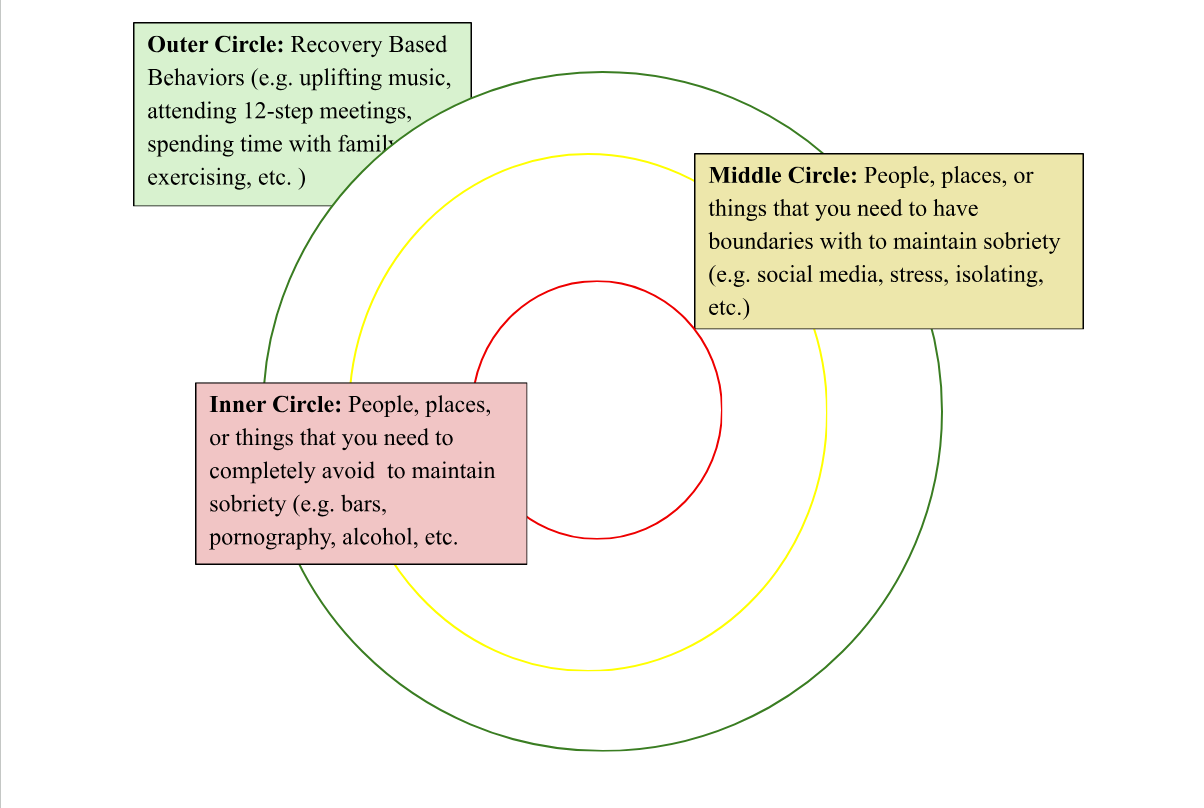
Three Circles Exercise:
Outer Circle:
In the outer circle, clients identify the things that help them live a life that feels aligned with their values. It is a way for them to clearly outline what a life of recovery looks like for them. It may be spending time with family and friends, attending church, exercising, praying, listening to uplifting music, or meditation. The idea is for clients to list as many people, places, or things that uplift them and help them spark joy in their lives.
Middle Circle:
The middle circle are behaviors that lead to vulnerability. This may be people, places, or things that increase the likelihood of relapse but don’t necessarily cause relapse. This is essentially, a list of things that client’s need to have boundaries with. For some, it may be frequenting a specific restaurant, spending time with a person they use to drink with, social media, secret keeping, or isolating.
Inner Circle:
The inner circle is our abstinence list. This is the things that clients must stay away from to maintain sobriety. For some, this could be alcohol, prescription medications, pornography, bars, clubs, etc.
Putting it in Practice:
The three circles exercise can be a meaningful tool for clinicians to help clients clearly identify their recovery behaviors, boundaries, and what they are truly abstaining from. It allows us to name addiction and recovery with greater clarity, which can make the process of taming it feel more intentional and manageable.
The opinions in CDP Staff Perspective blogs are solely those of the author and do not necessarily reflect the opinion of the Uniformed Services University of the Health Science or the Department of War.
Stefanie Araya is a Licensed Independent Social Worker located in South Carolina and works as a Military Mental Health Social Worker at the Consortium for Defense Psychology (CDP). She is also a Certified Sex Addiction Therapist (CSAT) and a Certified Sex Offender Treatment Professional (CSOTP).
References:
Blevins, T. (2023, January 19). SAA three circles for addiction recovery. Oak Mountain Coaching
Miller, J. (2025). Recovery from sex and love addiction: An exploration of the lived experience of twelve-step affiliation in Sex and Love Addicts Anonymous (Doctoral dissertation, Alliant International University). ProQuest Dissertations & Theses Global. https://www.proquest.com/openview/a4cd4bd0649cb1b34108e220825f59 1a/1
Research Update: 8 October 2026
October 8, 2026
The weekly Research Update contains the latest news, journal articles, and useful links from around the web. Some of this week's topics include:
● A Qualitative Preliminary Study of Ukrainian Healthcare Providers' Perspectives on Service Member's Mental Health Since the Russian Invasion.
● National trends in mental health outcomes among U.S. combat veterans by war era.
● Post-traumatic stress disorder (PTSD) in war: a comprehensive review of subtypes, risk and protective factors, and therapeutic approaches.
● Telehealth and Hybrid Service Use for Major Depression and Substance Use Disorders Among U.S. Adults, 2022–2023.
CLICK HERE TO READ THE 8 OCTOBER 2026 RESEARCH UPDATE